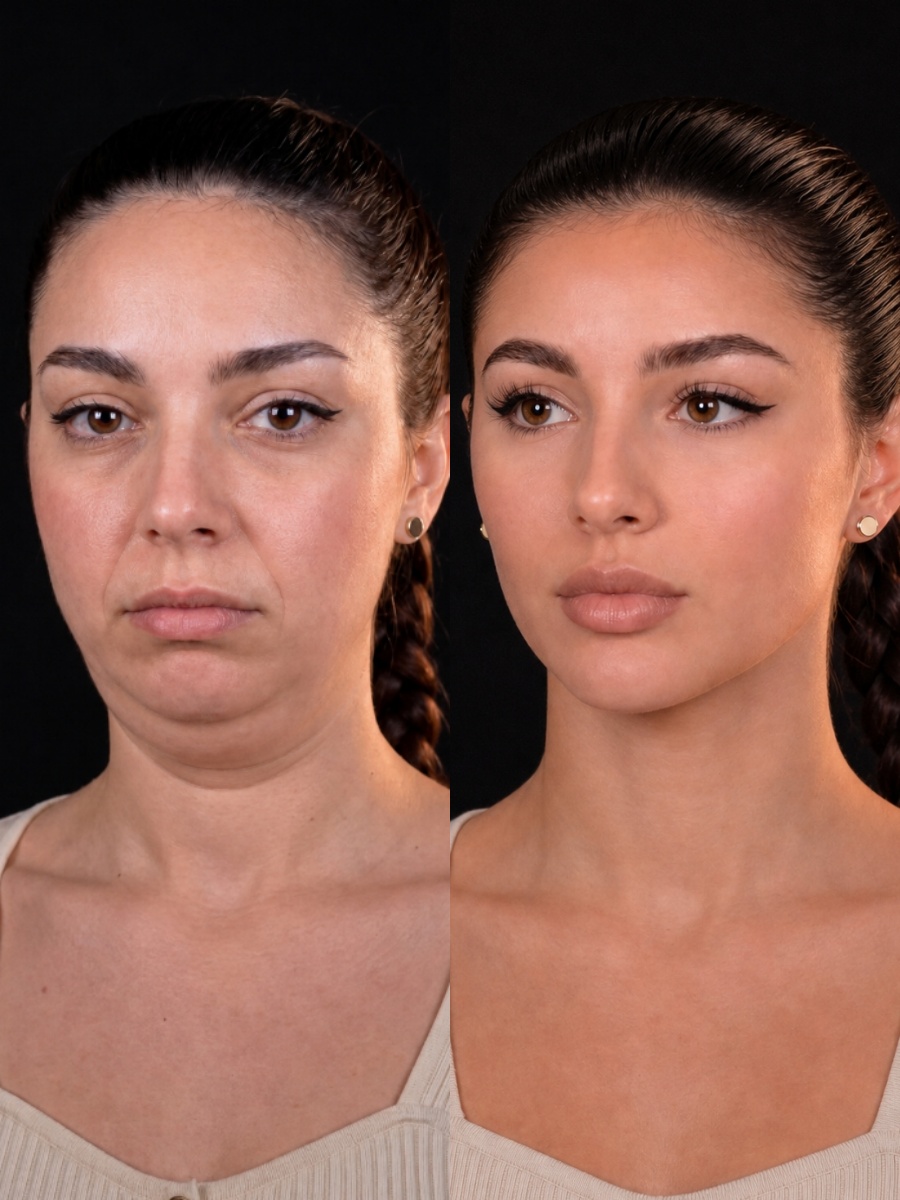
Many patients ask whether Tri-Plane Facelift and Tri-Plane Deep Plane Facelift are the same thing. The short answer is: they are related, but they are not identical.
Tri-Plane Facelift is Dr. Miles’s facial rejuvenation planning system. It looks at the face through multiple layers and dimensions: structure, skin, fat pads, support direction, incision design, expression, neck contour, and overall harmony.
Tri-Plane Deep Plane Facelift is a surgical technique that works in a deeper anatomical plane to release and reposition facial support structures.
The Simplest Way to Understand the Difference
Think of Tri-Plane Facelift as the strategy, and deep plane facelift as one possible method inside that strategy.
A patient with mild to moderate laxity may not need the deepest level of surgery. Another patient with heavier jowls, midface descent, and neck laxity may benefit from a deep plane approach. The correct answer depends on the face, not the label.
When Tri-Plane Facelift May Be Enough
Tri-Plane Facelift may be suitable when the patient needs natural lifting, improved lower-face definition, better jawline support, and refined anti-aging results without requiring the most extensive deep-plane release.
It may also be suitable for patients who want a careful, individualized plan and are not trying to chase the most aggressive procedure name online.
When Deep Plane Facelift May Be Considered
Deep plane facelift may be considered when the aging pattern is more structural. Common signs include pronounced jowls, heavier lower-face descent, deep nasolabial folds related to midface movement, neck laxity, and a tired facial shape that cannot be corrected by surface tightening alone.
Because the deep plane approach is more technically demanding, surgeon experience and patient selection are especially important.
Why the “Best Technique” Is Not the Same for Everyone
Patients often search for the newest or most famous facelift term. But the best technique is not always the most aggressive technique. A beautiful result comes from matching the surgical plan to the patient’s anatomy.
Age alone is not enough to decide. Skin quality, facial volume, previous filler or thread lift history, jawline structure, neck anatomy, and personal aesthetic preference all matter.
How Dr. Miles Evaluates the Choice
Dr. Miles evaluates facial aging through structure and expression. The consultation focuses on what actually causes the visible concern: skin laxity, ligament support, fat-pad descent, neck tissue, or a combination of factors.
This is why two patients with the same age may receive different recommendations. One may need a Tri-Plane Facelift plan with moderate lifting. Another may need a Tri-Plane Deep Plane Facelift. A third may need to postpone surgery or consider another approach.
Questions to Ask Before Choosing
Before deciding, ask: What layer is being treated? How is tension controlled? Where are incisions placed? How will my expression be preserved? What is the realistic recovery timeline? What risks should I understand?
If a consultation only gives you a procedure name without explaining the reasoning, that is not enough information for a serious decision.
To understand which approach may fit your face, begin with an online consultation. Send clear photos, describe your goals, and let the team evaluate the structure behind your concerns.
Want to learn more?
Contact us for a personalized consultation plan.
Book a 1-on-1 Online Consultation